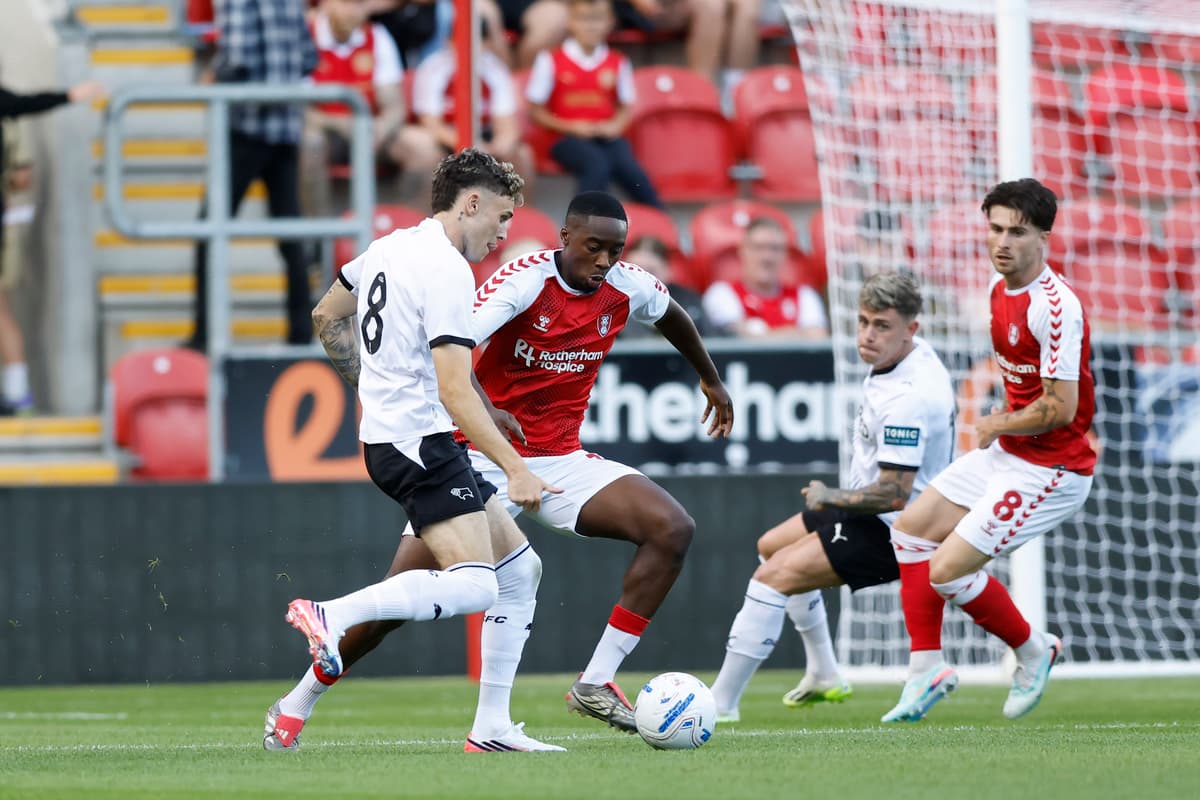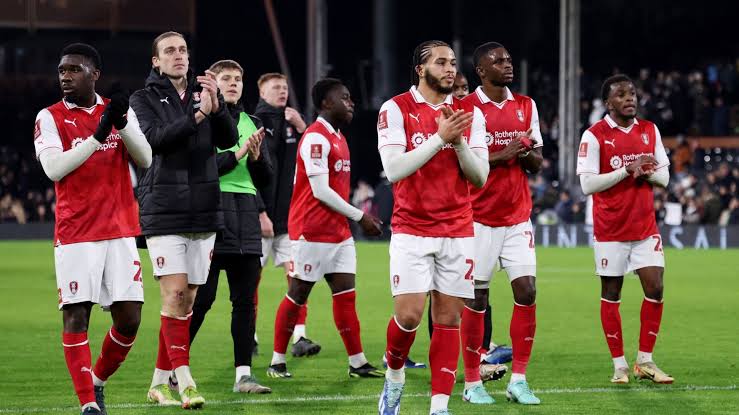
Rotherham United Football Club, nicknamed The Millers, is a professional association football club based in Rotherham, South Yorkshire, England. The club competes in EFL League Two, the fourth tier of English football. The club's colours were initially yellow and black, but changed to red and white around 1930. They have played home matches at the New York Stadium since 2012, having briefly moved to the Don Valley Stadium from their original home at Millmoor in 2008.
The club was formed as a merger between Rotherham County and Rotherham Town in 1925 and were immediately placed in the Football League. They won promotion as champions of the Third Division North in 1950–51 and were beaten finalists in the inaugural League Cup final in 1961, losing to Aston Villa 3–2 on aggregate. After seventeen seasons in the Second Division, relegations followed in 1968 and 1973. Promotion from the Fourth Division was secured in 1974–75 and the club went on to win the Third Division title in 1980–81. Relegations in 1983 and 1988 gave Rotherham the opportunity to win the Fourth Division title in 1988–89, though they had to win another promotion in 1991–92 following relegation the previous season. They beat Shrewsbury Town 2–1 in the 1996 final of the Football League Trophy.
The club's roots go back to 1877, when the club was formed as Thornhill Football Club (later Thornhill United). George Cook was the trainer around this time. For many years the leading team in the area was Rotherham Town, who spent three seasons in the Football League while Thornhill United were still playing in the Sheffield & Hallamshire League. By the turn of the century, however, Town had resigned from the Football League and gone out of business; a new club of the same name later joined the Midland League. Meanwhile, Thornhill's fortunes were on the rise to the extent that in 1905 they laid claim to being the pre-eminent club in the town and changed their name to Rotherham County. For a period both clubs competed in the Midland League, finishing first and second in 1911–12. Rotherham County became members of the second division of the Football league in 1919 whilst Rotherham Town failed to become elected to the third division northern section the following year. By 1925 County's fortunes had declined and they had to seek re-election to the third division. By this time it had become clear that to have two professional clubs in the town was not sustainable. Talks had begun in February 1925 and in early May the two clubs merged to form Rotherham United. Days later the reformed club was formally re-elected to the Football League under its new name.
The red and white kit was adopted around 1930 after playing in amber and black, but there was no improvement in the club's fortunes: in 1931 they again had to apply for re-election. Immediately after the Second World War things looked up. The Millers won the only post-war edition of the Football League Third Division North Cup in 1946 beating Chester 5–4 on aggregate. They then finished as runners-up three time in succession between 1947 and 1949 and then were champions of Division Three (North) in 1951. Rotherham reached their highest ever league position of third in the Football League Second Division in 1955, when only goal average denied them a place in the top flight after they finished level on points with champions Birmingham City and runners-up Luton Town. During that season they had notable results including a 6–1 win over Liverpool. In 1961 the Millers beat Aston Villa 2–0 at Millmoor in the inaugural League Cup final first leg; they lost the second leg 3–0 however at Villa Park. The second leg was played the season after due to Villa having a 'Congested Fixture List'. The club held on to its place in Division Two until 1968 and then went into a decline that took them down to Division Four in 1973. In 1975 they were promoted back to the Third Division finishing in the 3rd promotion spot in the Fourth Division. The Millers won the Division Three title in the 1980–81 season, and missed out on a second consecutive promotion by four points, finishing seventh In the second tier (then Division 2) 1981–82. They have not finished this high since. This season also saw Rotherham accomplish their highest-scoring second-tier league double, beating Chelsea 6–0 at home (31 October 1981) and 4–1 away at Stamford Bridge (20 March 1982).
During the 1990s Rotherham were promoted and relegated between the Football League's lowest two divisions and they slipped into the Fourth Division in 1991, just two years after being promoted, but reclaimed their status in the third tier (renamed Division Two for the 1992–93 season due to the launch of the FA Premier League) by finishing third in the Fourth Division in 1992. They survived at this level for five years, never looking like promotion contenders, before being relegated in 1997. In 1996 Rotherham United made their first trip to Wembley, beating Shrewsbury 2–1 to win the Football League Trophy, with two goals from Nigel Jemson giving Rotherham the win, with over 20,000 Rotherham United fans following them. In 1997, just after relegation to Division Three, Ronnie Moore took charge of Rotherham United. His first season ended in a mid-table finish and then his second in a play-off semi-final defeat on penalties to Leyton Orient. In 1999–2000 as Rotherham finished as Division Three runners-up and gained promotion to Division Two, where they finished runners-up and won a second successive promotion.
Rotherham managed to remain in Division One for four seasons, and after relegation to League One in 2005, Mick Harford took over as the Millers' manager, but was sacked after a run of 17 games without a win. Harford was replaced by youth team coach, Alan Knill. Early in 2006 it was announced that the club faced an uncertain future unless a funding gap in the region of £140,000 per month could be plugged. An intervention at the latest possible time by a consortium of local businessmen kept them in business. The final match of the 2005–06 season, home to Milton Keynes Dons, was a winner-take-all relegation showdown where a scoreless draw kept Rotherham up. Rotherham United began their second successive year in League One with a 10-point deficit as a result of the CVA which saved the club from liquidation. The club initially pulled the points back but, after losing key playmaker Lee Williamson and star striker Will Hoskins in the January transfer window, the Millers sat 13 points adrift of safety, making the threat of relegation inevitable. This resulted in Knill being sacked on 1 March, with Mark Robins becoming caretaker manager.